
 EN
EN
Practical Field Experience in Early Demand Assessment for Office Network Cabling
When it comes to office network cabling, many business owners and project managers tend to focus solely on immediate connectivity needs and overlook long-term operational growth, which often leads to repeated reconstruction, network lag and unnecessary cost waste in just a few years. Over the past sixteen years working in the structured cabling industry, our professional team has participated in hundreds of office network deployment projects across different regions and industries, from small startup offices with dozens of workstations to large-scale tech parks and mixed-use office buildings with thousands of network access points. One typical case was a medium-sized electronics manufacturing office that chose low-grade cables to cut initial costs three years ago. Within two years, the company expanded its team, added dozens of wireless access points, cloud office devices and real-time monitoring systems, and the original cabling system could no longer bear the surging data traffic. The company finally had to carry out a comprehensive cabling renovation, which not only interrupted daily production and office work but also generated extra labor and material expenses. This case has always reminded us that thorough demand assessment is the starting point of reliable office network cabling planning, and office network cabling must fully combine current business scale, daily network application types and predictable expansion plans in the next three to five years.
In the actual assessment process, our team will first classify all terminal devices in the office, including fixed office computers, IP phones, network printers, surveillance cameras, wireless AP equipment and mobile office access terminals, and count the number of basic network points one by one. Following the mature "N+1" layout principle for office network cabling, we reserve additional interfaces for each workstation and functional area to cope with temporary equipment access and post-expansion demands. For regional offices with large space span or multiple floors, we will also evaluate the layout of equipment rooms, intermediate distribution frames and wiring paths on site, mark areas with strong electromagnetic interference such as power distribution rooms and mechanical equipment areas, and record the building pipeline conditions, ceiling space and ground wiring channels. All these on-site investigation results will be sorted into a detailed demand document, which lays a solid foundation for the subsequent selection of cable models, design of cabling routes and configuration of supporting equipment. As a professional global cabling service provider with nearly 200,000 corporate clients worldwide, we always regard demand assessment as the core link to avoid subsequent network failures, and every detail in this stage is strictly implemented by our more than 1,000 professional service team members to ensure the planning scheme fits the actual operation of the office perfectly.
Professional Cable Model Matching Based on Office Application Scenarios
Selecting the right cable specifications is the core part of office network cabling overall planning, and mismatched cables will directly restrict network transmission speed, signal stability and service life. In accordance with international mainstream cabling standards, office network cabling involves multiple categories of cables from Cat5e to Cat8, and each type has its own applicable scenarios, transmission performance and environmental adaptability, so blind selection must be avoided. For ordinary small and medium-sized offices whose main daily applications are document transmission, web browsing and conventional video conferencing, Cat5e cables can meet the basic gigabit network demands, featuring stable signal transmission and high cost performance. For most modern standard office environments that require frequent large-file transmission, high-definition video meetings and multi-terminal concurrent access, Cat6 bulk ethernet cables become the mainstream choice. Our solid bare copper Cat6 cables adopt a cross separator structure inside, which effectively reduces crosstalk between wire pairs, supports stable gigabit transmission within 100 meters and short-distance 10Gbps transmission, fully matching the daily high-bandwidth use of modern offices.
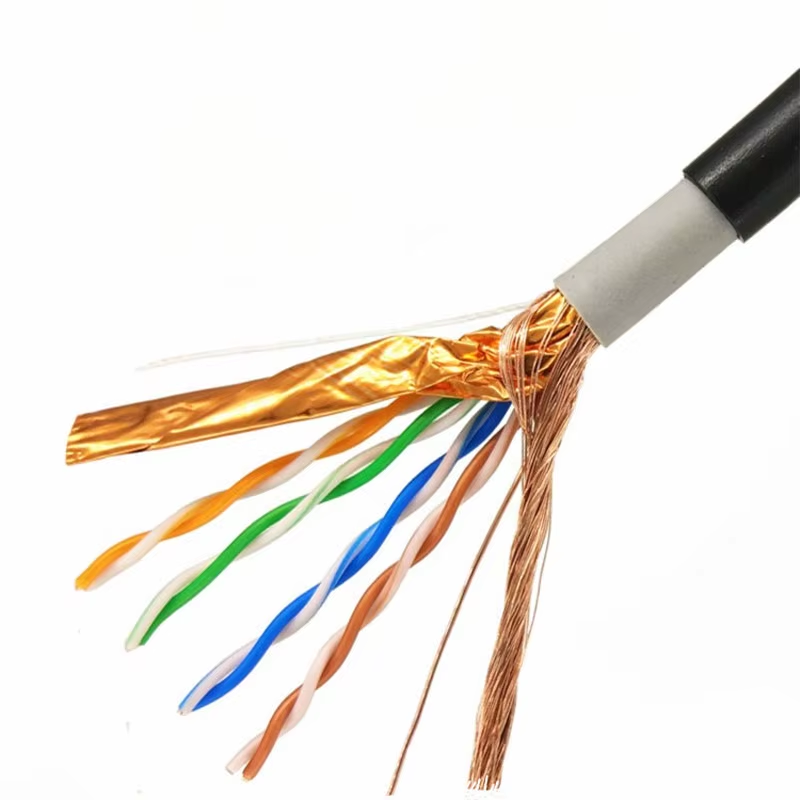
For office areas located near production workshops, power equipment or other environments with severe electromagnetic interference, we recommend outdoor Cat6 FTP shielded ethernet cables with PE jackets. This type of cable is equipped with solid copper drain wires, with excellent waterproof, ultraviolet resistance and anti-interference capabilities, which can prevent external electromagnetic signals from affecting network transmission and ensure continuous and stable network operation in harsh environments. For large enterprise office buildings, office areas connected to enterprise data centers and core office zones with ultra-high bandwidth demands such as design and research departments, Cat6A and Cat7 cables are more suitable. Our Cat6A cables have a bandwidth of 500MHz and can stably support 10Gbps transmission over the full 100-meter distance, while Cat7 cables with higher frequency bandwidth and multi-layer shielding structure perform better in long-distance high-speed transmission and signal confidentiality. As for Cat8 cables, which support 25Gbps to 40Gbps ultra-high-speed transmission, they are mainly used for short-distance connection between internal equipment in office equipment rooms and server cabinets, and are not suitable for horizontal cabling of conventional workstations due to their short effective transmission distance.
In addition to twisted-pair cables for horizontal office cabling, optical fiber products are also indispensable in the overall planning of large office network systems, especially for vertical trunk lines connecting floors and long-distance links between office areas and central equipment rooms. Our OS2 single-mode fiber optic patch cables and single-mode FC fiber optic patch cords adopt low-loss optical fiber cores and LSZH flame-retardant jackets, with small signal attenuation and strong anti-aging performance. They are widely used in office trunk line transmission and indoor optical terminal connection, realizing seamless docking between the office local area network and long-distance network lines. All our cables and fiber products have passed full-channel certification, complying with global cabling standards, so they can be perfectly compatible with various network equipment in different regions and effectively avoid compatibility problems in office network operation.
Scientific Layout Design of Cabling Routes and Supporting Infrastructure
A reasonable cabling route design and complete supporting infrastructure are important guarantees for the long-term stable operation and convenient daily maintenance of office network cabling. Many office network failures in daily operation are caused by irregular wiring paths, chaotic cable arrangement and unreasonable configuration of supporting facilities. Based on years of engineering experience and reference to the authoritative ANSI/TIA-568 and ISO/IEC 11801 cabling standards recognized by the global communications industry, we uniformly adopt a star topology for office network cabling layout. All workstation cables converge to the intermediate distribution frames of each floor first, and then connect to the main distribution frame in the central equipment room through trunk lines. This layout method realizes the isolation of network branches. When a single workstation or local area network fails, it will not affect the overall office network, and maintenance personnel can quickly locate the fault point, greatly improving the efficiency of daily operation and maintenance.
In terms of specific wiring path planning, we strictly control the length of horizontal cables from the distribution frame to the workstation. The horizontal link is limited within 90 meters, and the total length including desktop jumpers does not exceed 100 meters, which effectively reduces signal attenuation caused by excessive cable length. When designing pipelines and bridge frames, we fully consider the outer diameter and bending radius of different cables. For thick Cat6 and above cables, we reasonably control the filling rate of line pipes to prevent cables from being squeezed and twisted during laying. At the same time, we keep a safe distance between network cables and strong-current power lines to avoid electromagnetic interference. For the redundant cables reserved in each area, we organize and bind them in a standardized way, mark the corresponding information points clearly, and fix them on the bridge frames or suspended ceilings to prevent the cables from being crushed and damaged by external forces.
Supporting cabling equipment is equally important in the overall planning. Our complete set of structured cabling supporting products covers fiber optic patch panels, RJ45 keystone jack modules, professional cable management systems and various specifications of network cabinets. The fiber optic patch panels with LC connectors can realize neat management of fiber jumpers, and the LED indicator lights on the equipment help staff quickly check the link status. Multiple specifications of network cabinets ranging from 4U to 15U provide safe placement space for switches, distribution frames and other core equipment in the office equipment room. The matched cable management system sorts out a large number of cables in the cabinet in order, avoiding cable entanglement and heat dissipation obstacles. In the large-scale tech park campus network project we once undertook, the scientific route layout and standardized supporting equipment configuration ensured the stable operation of more than 3,500 network points for a long time, and won high recognition from the customer for the later maintenance convenience.
Redundancy Planning and Future Expansion Adaptation for Long-Term Office Operation
Excellent office network cabling overall planning must not only meet the current office demands but also reserve sufficient expansion space for future business iteration, team expansion and network technology upgrading, which is a key standard to distinguish ordinary cabling schemes from high-quality long-term planning solutions. Industry experts in the global communications field have repeatedly pointed out that office network systems are not short-term one-time construction projects. With the rapid development of cloud office, artificial intelligence applications, Internet of Things devices and remote office technologies, the bandwidth demand and terminal access quantity of office networks will continue to grow year by year. If there is no reasonable redundancy design in the early stage, the cabling system will become a bottleneck restricting enterprise development within a few years. Combining with the service experience of serving tens of thousands of corporate clients, we have formed a set of mature redundancy planning schemes suitable for different scales of offices.
In terms of network point redundancy, on the basis of counting the existing workstations, wireless devices and monitoring equipment, we reserve 20% to 30% of spare ports for distribution frames and switches. For open office areas, independent reserved network points are set in the spare positions of the space to facilitate the rapid access of new employees and temporary functional areas after team expansion. For core departments such as finance, administrative management and technical research and development that involve important business data, we adopt dual-link redundancy design. Two independent cabling paths are deployed for key network points. When one line fails, the other line can automatically take over the transmission task to ensure that the core business is not interrupted. In terms of trunk line redundancy, for vertical optical fiber trunk lines connecting floors and main lines connecting to external networks, we reserve 30% to 50% of redundant fiber cores on the basis of current usage volume, to cope with the bandwidth surge brought by the access of new office areas and new high-bandwidth business systems.
In terms of adapting to future network technology upgrades, our selected full-series cables from Cat5e to Cat8 and optical fiber products support the smooth migration of networks from 1G to 10G, 40G and even higher rates. The entire cabling architecture adopts a scalable design. When the office needs to upgrade the overall network rate or add new intelligent office systems, there is no need to re-lay a large number of cables. It only needs to replace part of the core switching equipment and match the corresponding jumpers to complete the network upgrade. In the one-stop FTTH and office network integration project for Southeast Asian operators completed by our team, the advanced redundancy and expansion design enabled the customer to complete the efficient deployment of 50,000 network ports in stages. This design concept is also fully applied to office cabling planning, helping every customer avoid repeated investment and realize the long-term value of the cabling system. Relying on 15 supply chain companies and more than 80 subsidiaries, we can also provide timely supplementary products and technical support for the subsequent expansion and transformation of office networks in different regions around the world.
Standardized Construction Testing and Full-Cycle After-Sales Service to Ensure Cabling Quality
The perfect overall planning of office network cabling needs to be implemented through standardized construction and strict testing, and reliable full-cycle services can maintain the long-term stable operation of the cabling system. Many well-designed cabling schemes end up with poor network performance due to non-standard construction operations and incomplete acceptance testing. As a national high-tech enterprise focusing on structured cabling and network connectivity solutions for a long time, we have formulated a set of standardized construction operation specifications suitable for global office scenarios based on international industry standards and years of on-site construction experience, and all construction personnel have received professional pre-job training to ensure that every construction link is operated in accordance with the rules.
During the cable laying process, the team strictly controls the traction force of the cables to avoid damaging the internal wire cores due to excessive pulling. When bending the cables, they follow the standard bending radius requirements to prevent signal transmission failure caused by cable distortion. For shielded cables used in anti-interference areas, the grounding construction is done in place to give full play to the shielding performance. After all cabling construction is completed, we will use professional testing instruments to conduct comprehensive tests on all links, including cable connectivity, signal attenuation, crosstalk, bandwidth and other core indicators. Each link must meet the parameter standards of the corresponding cable category before it can be delivered for use. At the same time, we sort out all test reports, cabling layout drawings, cable model lists and other documents and hand them over to the customer, forming complete file records for the later daily maintenance and equipment upgrade of the office network.
We provide full-cycle professional services covering the whole process from scheme design, product supply, on-site construction, quality inspection to after-sales maintenance for office network cabling projects. Our more than 1,000 professional service teams can respond to customer demands around the world in a timely manner. In the daily after-sales stage, we provide regular network inspection services to check the operating status of cables, supporting cabinets, distribution frames and other equipment, eliminate potential hidden dangers in advance. When customers encounter network failures or need technical transformation, our technical team can quickly provide remote guidance or on-site maintenance services. Different from ordinary product suppliers, we rely on a data-driven closed-loop operation system to realize the visualization and traceability of the whole project process. Every link from product production to construction and after-sales can be tracked, which fundamentally guarantees the quality of office network cabling projects. Over the years, with strict construction standards, perfect testing links and thoughtful full-cycle services, our office cabling solutions have been applied to teaching hospitals, electronic manufacturing factories, financial data centers and various office buildings in many regions, and have maintained a stable operating state for a long time, winning consistent trust from global enterprise customers.
Table of Contents
- Practical Field Experience in Early Demand Assessment for Office Network Cabling
- Professional Cable Model Matching Based on Office Application Scenarios
- Scientific Layout Design of Cabling Routes and Supporting Infrastructure
- Redundancy Planning and Future Expansion Adaptation for Long-Term Office Operation
- Standardized Construction Testing and Full-Cycle After-Sales Service to Ensure Cabling Quality