
 EN
EN
Practical Project Experiences Showing Real-World Performance of Fiber Optic Signal Transmission
Over sixteen years working in the global structured cabling and network connectivity industry, I have taken charge of countless projects that rely heavily on fiber optic solutions, ranging from large-scale campus networks and industrial facilities to long-distance FTTH deployment across multiple regions. One memorable experience took place during the network upgrade for a manufacturing plant with 800 LAN and CCTV connection points. The client originally used traditional copper cables for core signal transmission, and they constantly struggled with slow data transfer, signal interference from nearby production machinery, and frequent disconnections for high-definition monitoring streams. After we replaced the main transmission lines and key jumpers with our fiber optic products including OS2 G652D single-mode fiber optic patch cords and fiber distribution components, the entire network ran much more smoothly. Even in areas filled with electric motors and power equipment, the video signals and production data maintained steady transmission without any interference issues.
Another notable case was a large tech park with more than 3,500 network nodes. Given the long distance between different office buildings and high demand for simultaneous access to cloud services and large file sharing, we built a complete trunk transmission system using our full-range fiber optic products. During years of daily operation, the fiber optic links never suffered from the performance degradation that commonly plagues copper cables. These real cases have made it clear to our entire technical team that fiber optic stands out as a reliable choice for modern communication infrastructure. Many network managers still hold misunderstandings about how light travels inside fiber optic lines, and improper use often leads to unnecessary performance loss. Learning the basic working principles will help users maximize the advantages of our certified fiber optic products and build more stable network systems. Our company has served nearly 200,000 corporate clients around the world, and we always combine practical project feedback with professional theories to guide clients in proper product selection and application.
Basic Physical Structure of Fiber Optic and Its Matching Functional Design
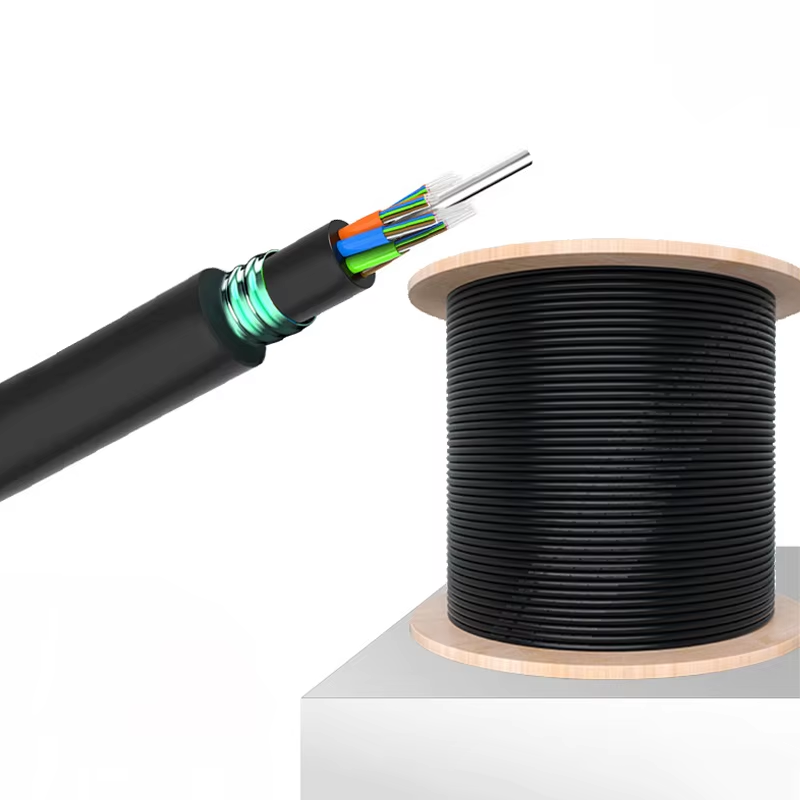
To figure out how fiber optic transmits light signals, we first need to get familiar with its layered physical structure, as every part is carefully designed to serve long-distance and low-loss light propagation. A standard communication-grade fiber optic consists of three core layers: the central core, the surrounding cladding, and the outer protective coating. The core is made of high-purity silica glass with a relatively high refractive index, which acts as the main channel for light signal travel. The cladding wraps tightly around the core, using silica glass with a slightly lower refractive index, and its key role is to confine light within the core instead of letting it leak out. The outermost coating, usually made of LSZH or PE materials, provides physical protection against friction, moisture and ultraviolet damage during laying and daily use.
All fiber optic products from our brand strictly follow international manufacturing standards. Our OS2 single-mode fiber optic patch cords and FC or LC fiber optic jumpers adopt precision drawing and polishing techniques. The core diameter and the concentricity between the core and cladding are controlled within extremely tight tolerance ranges, which lays a solid foundation for stable light transmission. Different from multi-mode fiber optic used for short-distance transmission, the single-mode fiber optic we mainly promote has an ultra-fine core structure. This design restricts light to travel along a single path inside the core, effectively eliminating signal distortion caused by multiple light paths and ensuring high fidelity of data signals.
Industry experts specializing in optical communication point out that the subtle difference in refractive index between core and cladding is the most critical structural feature of functional fiber optic. If this parameter fails to meet the standard, even high-quality raw materials cannot achieve effective light transmission. Our production workshops conduct strict sampling tests on the refractive index of each batch of fiber optic raw materials and finished products. Every finished fiber optic product passes full-channel certification, so the structural stability and transmission performance can remain consistent in complex environments such as outdoor wiring, crowded server cabinets and indoor terminal connections.
Core Optical Principle of Total Internal Reflection for Fiber Optic Signal Propagation
The core working principle behind fiber optic light signal transmission is the physical phenomenon known as total internal reflection, a basic optical rule that has been widely applied in modern communication technology. When light travels from a medium with a higher refractive index to one with a lower refractive index, two situations will occur based on the incident angle. If the incident angle is smaller than the critical angle, part of the light will refract into the adjacent medium, and the rest will reflect back. Once the incident angle exceeds the critical angle, all light will be completely reflected back to the original medium, with no refracted light escaping. This is exactly how light moves inside fiber optic.
When a light signal carrying digital data is injected into the core of fiber optic, it hits the boundary between the core and cladding at an angle larger than the critical angle. The light bounces back and forth between the two layers continuously, moving forward along the axial direction of the fiber optic. This repeating reflection process allows light signals to travel several kilometers or even hundreds of kilometers with very low energy loss. According to the specifications of ITU-T G.652D standards that our fiber optic products comply with, the signal attenuation of OS2 single-mode fiber optic is controlled at an extremely low level. In the 1550nm common working wavelength window, the typical attenuation value is only around 0.2dB per kilometer, which means the signal can maintain strong power after long-distance transmission.
Many on-site technicians have found that excessive bending of fiber optic will cause network lag or disconnection, and this phenomenon can also be explained by the total internal reflection principle. Sharp bends will change the incident angle of light on the core-cladding boundary. When the angle drops below the critical angle, a large amount of light will leak into the cladding, forming obvious bend loss. Our fiber optic products have optimized the internal structural flexibility while ensuring transmission performance. Even under normal bending conditions within the standard radius, the light path can remain stable, which is why our fiber optic performs well in dense wiring environments inside 4U to 15U network cabinets and narrow indoor wiring corners.
Signal Conversion Process and Working Flow in Complete Fiber Optic Transmission Systems
A single fiber optic can only complete the transmission of light signals, while a practical communication system needs a complete set of devices to realize the whole process from data generation to information reception. In actual network construction, the fiber optic we provide works with optical transceivers, OLT devices, optical splitters and ONT terminals to form a closed transmission loop. The entire workflow includes electro-optical conversion, light signal transmission and photoelectric conversion, and each link is closely connected.
At the signal sending end, electrical signals carrying text, video, voice and other data are converted into modulated light signals by optical modules or optical transceivers. These focused light signals are then injected into the fiber optic core through precision connectors such as LC and FC. After long-distance transmission via fiber optic trunk lines, distribution boxes and various fiber optic patch cords, the light signals arrive at the receiving end. At this point, the photoelectric conversion device converts the light signals back into standard electrical signals, which are then identified and processed by network switches, computers and other terminal equipment. In the one-stop FTTH projects we delivered for Southeast Asian operators with 50,000 deployment ports, this mature transmission flow was adopted across the entire system, achieving efficient and stable large-scale signal delivery.
Our supporting fiber optic accessories are designed to match this full transmission flow perfectly. The fiber optic patch panels equipped with LC connectors can neatly arrange numerous fiber optic lines and ensure accurate docking of light paths. The precisely polished end faces of our fiber optic patch cords reduce insertion loss during signal docking to the minimum. Different types of fiber optic products we offer cover trunk line transmission, cabinet jumpers and indoor terminal wiring scenarios. Whether it is a hyperscale data center supporting 40G, 100G and 400G network migration or a conventional office network, our matched fiber optic solutions can guarantee seamless connection of each signal link. Relying on a data-driven closed-loop operation system, we also track the operating data of fiber optic products in various projects to continuously optimize product performance according to actual transmission demands.
Advantages of Fiber Optic Transmission and Selection Guidance for Different Application Scenarios
Understanding how fiber optic transmits light signals also helps us recognize its inherent advantages over traditional copper cables, which is why fiber optic has gradually become the mainstream medium for modern high-speed communication. First of all, fiber optic relies on light for signal transmission, so it will not be affected by electromagnetic interference from power lines, motors and industrial equipment. This makes our fiber optic products ideal for industrial workshops, power distribution rooms and other harsh environments. Secondly, fiber optic has extremely low signal attenuation and wide bandwidth. Our OS2 G652D single-mode fiber optic supports ultra-long-distance transmission and can carry high-capacity data streams, fully adapting to the bandwidth requirements of cloud computing, high-definition video conferences and large-scale data backup.
In addition, fiber optic features good safety performance and long service life. The raw material of fiber optic does not conduct electricity, so there is no risk of electric leakage or short circuit. The anti-aging outer coating enables our fiber optic to work stably for a long time whether used indoors or outdoors. Combined with the project experience accumulated by our 1,000 plus professional service team, we have sorted out clear selection suggestions for different scenarios. For long-distance trunk lines between buildings, campus backbone networks and FTTH main lines, it is recommended to use our standard OS2 G652D single-mode fiber optic series, which balances low loss and cost performance. For short-distance jumpers inside data center cabinets and equipment rooms, our high-performance fiber optic patch cords with LSZH jackets are the preferred option, thanks to their fire resistance and compact structure.
For outdoor cabling exposed to wind, rain and sunlight, choose our outdoor-grade fiber optic with PE jackets, which has excellent waterproof and ultraviolet resistance. Many clients worry about the difficulty of daily maintenance after deploying fiber optic systems. In fact, as long as users follow the transmission principle of fiber optic, avoid excessive bending and sharp pulling, and do not pollute the connector end faces, the fiber optic can maintain stable performance for more than a decade. Backed by 15 supply chain companies and over 80 subsidiaries around the world, we can provide timely technical guidance and product support for global clients. By choosing our professional fiber optic products and using them in line with transmission characteristics, every user can build a high-speed, stable and future-proof communication network.
Table of Contents
- Practical Project Experiences Showing Real-World Performance of Fiber Optic Signal Transmission
- Basic Physical Structure of Fiber Optic and Its Matching Functional Design
- Core Optical Principle of Total Internal Reflection for Fiber Optic Signal Propagation
- Signal Conversion Process and Working Flow in Complete Fiber Optic Transmission Systems
- Advantages of Fiber Optic Transmission and Selection Guidance for Different Application Scenarios